


ООН0209 производителей
HX-752 Supply for Solid Propellant and Energetic Material Applications
HX-752 is the commercial designation for 1,1′-isophthaloyl bis(2-methylaziridine), a difunctional acyl aziridine used as a specialty curative and bonding agent. It is identified by CAS No. 7652-64-4, EC No. 231-617-5 and the molecular formula C14H16N2O2. Published product literature describes HX-752 as a colorless-to-yellowish viscous liquid or a whitish solid near room temperature, depending on temperature and crystallization history.
ORBITALA supports qualified organizations seeking HX-752 manufacturers and suppliers in Europe, the EU and international markets. A compliant purchase requires more than a product name. Buyers should confirm the exact chemical identity, original manufacturer, production country, approved technical specification, batch certificate, storage history, remaining shelf life and applicable export-control route before accepting an offer.
HX-752 Manufacturers & Suppliers - Table of Contents:
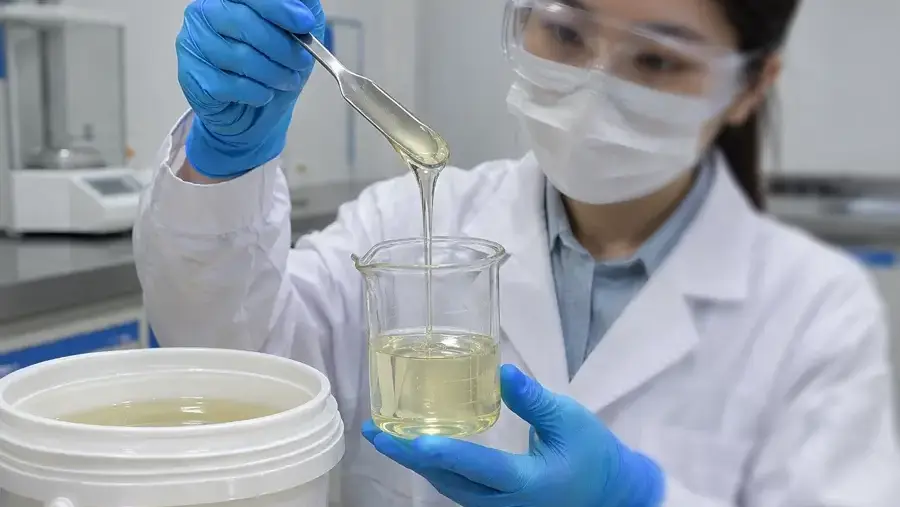
Laboratory technician sampling pale yellow viscous HX-752 during quality control testing.
What Is HX-752?
HX-752 is a difunctional aziridine amide derived from isophthalic acid chemistry and propylene imine. The molecule contains two reactive 2-methylaziridine groups attached through amide linkages to an isophthalic backbone. This combination gives HX-752 both polar functionality and reactive aziridine rings, making it useful in selected polymer and highly filled composite systems.
The material belongs to the broader class of acyl aziridine bonding agents. Published technical literature explains that HX-752 can react with carboxylic acids through ring opening to form ester-amide linkages. In the presence of acidic species, it can also react with alcohol functionality to form ring-opened ether-esters. These reactions can occur without the release of a small-molecule by-product, allowing the material to function as a chain extender, crosslinker or interfacial bonding agent in an appropriately qualified system.
HX-752 should not be confused with HX-878, HX-879, HX-868 or MAPO. These materials are all associated with bonding-agent applications, but they have different chemical identities, functional groups, specifications, hazards and regulatory classifications. A familiar HX designation is not evidence of equivalence.
HX-752 Product Overview
These values identify the substance and summarize published information. They are not universal contractual acceptance limits. The current manufacturer specification, safety data sheet and batch-specific certificate of analysis should control each purchase.
How Does HX-752 Function?
Highly filled polymer composites rely on effective adhesion between solid particles and the surrounding binder. When the interface is weak, mechanical loading can concentrate around particle surfaces, increasing the risk of localized debonding, void growth and inconsistent strain response. HX-752 is selected to improve this interface in systems for which the material has been technically approved.
Its polar amide groups can support interaction with selected solid surfaces, while the aziridine groups can undergo ring-opening reactions under suitable chemical conditions. The material can therefore help connect the particle interface with the polymer network. In ammonium-perchlorate-containing polybutadiene matrices, published product literature identifies HX-752 specifically as a bonding agent.
Performance is formulation-specific. Particle chemistry, surface condition, moisture, binder type, curative system, catalyst package and storage history can all influence the result. HX-752 should be evaluated within the complete authorized formulation, and any change in manufacturer or grade should pass the customer's documented qualification process.
Main Applications of HX-752
Bonding Agent in HTPB Composite Systems
HX-752 is used in selected hydroxyl-terminated polybutadiene, or HTPB, composite binder systems. Its purpose is to improve the interface between compatible particulate solids and the polyurethane-based elastomeric matrix. Effective interfacial bonding can support mechanical consistency and strain capability in the cured composite when the full material system and manufacturing process are properly qualified.
Ammonium Perchlorate Filled Composites
Historical manufacturer literature describes HX-752 as a bonding agent for ammonium perchlorate in polybutadiene matrices. The material is associated with the particle surface and the surrounding binder network, helping reduce the likelihood of interfacial separation. Suitability depends on the exact oxidizer grade, binder, curative and additive package; product selection should be made by the responsible technical authority.
Chain Extension and Crosslinking
Because acyl aziridines can react with carboxylic acids and, under suitable acidic conditions, with alcohol functionality, HX-752 may be evaluated as a chain extender or crosslinker in compatible functional polymers. These applications require controlled testing because cure behavior, viscosity development and final properties depend on the complete formulation rather than on HX-752 alone.
Specialty Filled Polymer Systems
The chemistry may also be considered for other specialized, highly filled polymer or elastomer systems that need improved filler-to-binder adhesion. An application outside the established reference use should be treated as a separate development program. Product literature does not replace compatibility testing, safety review or performance qualification.
Technical Specifications and Quality Parameters
Published values for HX-752 vary with grade, test temperature and whether the material is in a supercooled liquid state. The table below combines typical information from historical commercial literature and current supplier listings. It is intended for preliminary comparison only.
Where required by the purchasing program, HX-752 should comply with MIL-I-85492, with the applicable revision, test methods and acceptance limits confirmed in the purchase specification.
A marketplace listing that states only a nominal purity should not be accepted as a complete HX-752 specification. Identity, equivalent weight, moisture, viscosity, appearance and storage history can be more relevant to functional consistency. The purchase contract should name the controlling analytical methods and limits.
HX-752 Grade Equivalence and Product Identification
HX-752 has been sold under commercial and supplier-specific names, including historical Dynamar references and current equivalent listings. The common designation helps identify the chemistry, but it does not guarantee that every offered product has the same residual profile, storage history, viscosity, analytical method or application performance.
-
Confirm the exact designation HX-752 and chemical name 1,1′-isophthaloyl bis(2-methylaziridine).
-
Match CAS No. 7652-64-4, EC No. 231-617-5 and molecular formula C14H16N2O2.
-
Identify the original manufacturer and named production site, not only the sales office or dispatch warehouse.
-
Obtain the current technical specification, safety data sheet and batch-specific certificate of analysis.
-
Verify packaging, storage temperature, production date and remaining approved shelf life.
-
Require documented technical approval when replacing a previously qualified source or commercial grade.
HX-752 is not interchangeable with HX-868, HX-874, HX-877, HX-878, HX-879, MAPO or another aziridine or polyamine bonding agent. Similar function does not establish chemical or performance equivalence.
HX-752 Manufacturers and Suppliers in Europe and the EU
Organizations searching for HX-752 manufacturers EU or HX-752 suppliers EU may find specialist distributors, laboratory vendors and project-based sourcing companies more readily than public evidence of a dedicated European manufacturing plant. An EU warehouse, invoice address or sales office does not prove European manufacture.
For HX-752 Europe procurement, the buyer should request the original producer, manufacturing country, batch number, specification, certificate of analysis and storage record. EU chemical obligations must be assessed for the actual importer, annual tonnage, legal entity and intended use. ECHA identifies the substance under CAS No. 7652-64-4 and EC No. 231-617-5, but an inventory or registration reference is not a general authorization for every transaction.
HX-752 is also specifically identified in the Common Military List of the European Union within the category of polyfunctional aziridine amide bonding agents. Export, transfer, import, transit, end-user and end-use documentation may therefore be required. Regulatory review should occur before a commercial commitment is made.
Regions Where HX-752 Is Manufactured
HX-752 production is concentrated among specialist fine-chemical and aerospace-material manufacturers capable of controlling reactive aziridine chemistry, low-temperature storage and regulated supply chains. Public information is limited, and many companies advertising HX-752 are traders or research-chemical suppliers. Buyers should separate documented manufacturing origin from distribution location.
United States
The United States is historically associated with HX-752 through 3M's Dynamar curative and bonding-agent grade. A 2019 3M safety data sheet identifies 3M as the manufacturer, while earlier product literature provides typical properties, storage and packaging information. Buyers should confirm current commercial availability, production site and export eligibility directly for each transaction; historical literature and a corporate address do not by themselves establish present-day manufacturing status.
China
China has the clearest publicly visible current supply base for HX-752. Chinese specialty-chemical manufacturers list 1,1′-isophthaloyl bis(2-methylaziridine), CAS No. 7652-64-4, in commercial quantities and several publish assay or packaging information. Supplier claims should still be verified through plant identification, quality-system evidence, batch traceability, certificate-of-analysis practices and confirmation that the seller is the original manufacturer rather than a reseller.
South Korea
South Korea has established specialty-chemical and aerospace-material capabilities, and Korean suppliers publicly list HX-752 among bonding-agent products. A buyer should request written confirmation of the manufacturing site, country of origin and whether the seller produced, purified or merely distributed the batch. The technical dossier should connect the offered material to a named plant and current specification.
Europe
Europe has qualified aerospace users, chemical distributors and controlled-material logistics networks, but publicly documented dedicated HX-752 manufacturing capacity is limited. Product offered by an HX-752 supplier in Europe may originate in North America or Asia. European purchasers should verify the original producer, plant location, regulatory basis and export-control route before describing the material as European-made.
Saudi Arabia
Saudi Arabia is expanding its aerospace, defense and specialty-chemical industries, creating potential demand for controlled bonding agents. Public manufacturer documentation reviewed for this article does not establish a dedicated Saudi HX-752 production plant. Supply into the country is therefore more likely to involve licensed import or program-specific sourcing unless a vendor provides auditable evidence of local manufacture, quality control and origin.
Singapore
Singapore is a major regional center for specialty-chemical trading, storage and re-export. Its advanced logistics infrastructure can support temperature-sensitive materials, but public evidence of dedicated commercial HX-752 production in Singapore is limited. A Singapore-based offer should identify the original manufacturing country and producer and should be reviewed under the applicable strategic-goods, import and re-export controls.
Taiwan
Taiwan has sophisticated fine-chemical, polymer, electronics and aerospace supply chains. Nevertheless, publicly verifiable evidence of a dedicated Taiwanese HX-752 production site remains limited. Buyers should determine whether a Taiwan-based company is the original manufacturer, a custom synthesizer, a laboratory supplier or an importer, and should require a certificate of origin and batch documentation before assigning local manufacture.
United Arab Emirates
The United Arab Emirates is an important logistics and re-export hub for industrial chemicals serving the Middle East. Public sources do not clearly establish large-scale HX-752 manufacture in the UAE. Regional supply may be arranged through controlled importers and project suppliers, but a UAE warehouse or invoice address should not be treated as proof of local production. The original manufacturer, plant, storage history and regulatory eligibility should be documented.
Quality Assurance and Batch Acceptance
HX-752 purchasing should be supported by a written batch-acceptance plan. The required depth depends on the approved application, but identity, active content, equivalent weight, moisture, viscosity and storage condition should be confirmed before the material is released for use.
The contract should identify the controlling test methods, sampling plan, release authority, retest rules and response to nonconforming material. A generic certificate should not be accepted in place of a document tied to the physical batch.
Packaging, Storage and Transportation
Packaging varies by producer and supply program. Historical 3M product information listed one-pound, eight-pound and 44-pound units. Current supplier listings may offer 1 kg, 5 kg, 10 kg or 25 kg containers. The selected package should be compatible with the material, resistant to moisture ingress, traceable and suitable for the approved transport route.
Historical commercial literature recommended storage at -18°C and stated a shelf life of at least one year under those conditions. It also noted that HX-752 can remain supercooled or slowly crystallize during storage and that crystallization does not necessarily reduce product quality. Current storage instructions can differ by grade and supplier, so the latest technical data sheet and SDS for the delivered batch must govern.
Earlier manufacturer literature described shipment in insulated cartons with dry ice to maintain stability. That practice should not be applied automatically to every modern grade. The supplier must define the validated transport temperature, compatible packaging, maximum transit time and procedure for temperature excursions. Shipment classification and labels should be taken from the current SDS and carrier assessment for the exact product and route; no UN number should be inferred from the HX-752 name alone.
Health, Safety and Handling Considerations
HX-752 is an industrial chemical for trained professional use. A 2019 3M safety data sheet classified the referenced commercial grade for corrosivity, harmful acute oral toxicity, serious skin and eye damage, reproductive toxicity, suspected mutagenicity and repeated-exposure target-organ effects. The exact classification of another supplier's grade must be taken from its current jurisdiction-specific SDS.
Workplace controls should be based on a documented exposure assessment and the supplier's safety instructions. Compatible closed packaging, engineering controls, suitable protective clothing, eye and face protection and controlled access may be required. HX-752 should be kept away from incompatible materials identified in the SDS, and any waste or contaminated packaging should be managed through an authorized hazardous-waste route.
Published information also warns that hazardous polymerization may occur if the material is overheated. Storage, thawing or conditioning practices should therefore come from the current manufacturer documentation and the user's approved safety procedures. Public product-page content should not be treated as an operating instruction.
Regulatory and Export Control Considerations
HX-752 procurement can be subject to chemical regulation, military-list controls and destination-country licensing. The applicable requirements depend on the country of manufacture, exporter, destination, consignee, end user and end use.
-
The Common Military List of the European Union specifically includes HX-752, CAS No. 7652-64-4, among controlled polyfunctional aziridine amide bonding agents.
-
The United States Munitions List identifies HX-752 within its controlled bonding-agent category.
-
The referenced 3M SDS states that the material may contain ingredients regulated under the United States International Traffic in Arms Regulations.
-
ECHA identifies the substance under EC No. 231-617-5 and CAS No. 7652-64-4; REACH and national obligations must be assessed for the actual importer and transaction.
-
Export, import, transit, re-export, end-user and end-use approvals may be required before shipment or technical disclosure.
Regulatory eligibility should be established before stock is reserved, repacked or dispatched. A technically suitable material cannot be supplied when the transaction does not satisfy the applicable licensing and compliance requirements.
Selecting an HX-752 Manufacturer or Supplier
A reliable HX-752 supplier should connect the commercial offer to an identifiable manufacturing source, a current specification and a complete batch dossier. Nominal availability and price are not sufficient when the material must remain consistent with an approved technical program.
-
Confirm whether the company is the original manufacturer, an authorized distributor or an independent trader.
-
Verify the named production site and the quality-system scope covering HX-752.
-
Compare the proposed grade with the approved reference for identity, assay, equivalent weight, viscosity, moisture and appearance.
-
Review batch traceability, change-control procedures and certificate-of-analysis practices.
-
Confirm packaging, storage temperature, transport controls and minimum remaining shelf life at delivery.
-
Assess export-control, import, transit, end-user and end-use documentation before order confirmation.
-
Define inspection, rejection, return and replacement responsibilities in the purchase agreement.
Information Required for an HX-752 Quotation
A complete inquiry allows HX-752 suppliers to evaluate technical fit, regulatory eligibility and delivery feasibility without avoidable delays. Qualified buyers should provide:
-
Exact product designation, chemical name, CAS number and any approved manufacturer reference.
-
Required technical specification, revision, test methods and acceptance limits.
-
Requested quantity and preferred packaging configuration.
-
Destination country, consignee and authorized delivery location.
-
End user and authorized end use.
-
Required delivery schedule and minimum remaining shelf life.
-
Required certificate of analysis, SDS, origin statement and quality documents.
-
Inspection, sampling or witness-testing requirements.
-
Available import authorization, end-user certificate or other regulatory documents.
-
Restrictions on manufacturing country, producer, repacking or transit route.
How ORBITALA Supports HX-752 Procurement
ORBITALA works with qualified industrial, aerospace and defense-sector customers seeking HX-752 suppliers in Europe, the EU and international markets. Support may include confirming the requested product identity, comparing available specifications, identifying potential manufacturing sources and coordinating the technical and commercial documentation required for evaluation.
ORBITALA may also assist with packaging alignment, batch-document requirements, country-of-origin confirmation, storage expectations and planning a compliant delivery route. Every transaction remains subject to technical acceptance, product availability, manufacturer approval, destination restrictions, end-user verification and all applicable export, import and transit authorizations.
Frequently Asked Questions
Request Information About HX-752
Organizations seeking HX-752 should provide the required grade or approved manufacturer reference, technical specification, quantity, packaging, destination country and requested delivery schedule. The inquiry should identify the consignee, end user and authorized application and include any available import permits, end-user documentation or origin restrictions. ORBITALA will review the request to assess technical compatibility, product availability and the feasibility of a compliant procurement and delivery route. Contact ORBITALA OOD.