


ООН0209 производителей
Catocene Supply for Solid Propellant and Energetic Material Applications
Catocene is the trade name commonly used for 2,2-bis(ethylferrocenyl)propane, an iron-containing organometallic liquid used as a burn-rate catalyst in composite solid propellant systems. Buyers searching for Catocene manufacturers or Catocene suppliers in Europe should verify the chemical identity, grade, specification, country of origin, safety data and export-control status before placing an order. ORBITALA supports qualified industrial, aerospace and defense-sector customers with technical sourcing, documentation and compliant supply coordination, subject to applicable regulatory and end-use requirements.
Catocene Manufacturers & Suppliers - Table of Contents:
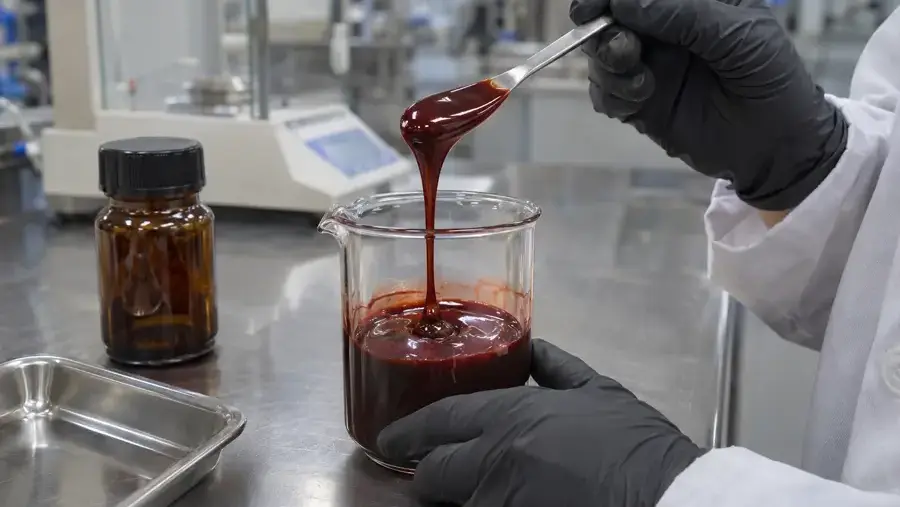
Laboratory technician testing the viscosity of dark red Catocene in a glass beaker.
What Is Catocene?
Catocene is a ferrocene-derived organometallic compound. It is generally identified as 2,2-bis(ethylferrocenyl)propane and is often abbreviated as BEFP in technical and commercial documentation. The material is typically supplied as a brown-red viscous liquid rather than as a conventional dry catalyst powder.
Its principal commercial role is to modify combustion behavior in qualified composite solid propellant systems. Published technical literature describes Catocene as a liquid ferrocene-based burn-rate catalyst that can promote the thermal decomposition of ammonium perchlorate and increase propellant burning rate. The actual result depends on the complete formulation, raw-material quality, processing history and qualification method. Catocene should therefore be evaluated within the customer's approved system rather than treated as a universal performance additive.
Catocene is a specialized and controlled material in many jurisdictions. Availability on a supplier website does not establish that a product is suitable for a specific aerospace or defense program, eligible for export, or manufactured by the named seller. Professional procurement requires confirmation of the producer, production site, batch documentation and authorized end use.
Chemical Identity and Commercial Names
The name Catocene is used inconsistently across catalogs. CAS 37206-42-1 is the identifier used in major regulatory references, while some commercial listings also associate CAS 69279-97-6 with the same common chemical name. A purchase order should state the accepted identifier and require the supplier's SDS, technical data sheet and Certificate of Analysis to use consistent nomenclature. If the documents conflict, the manufacturer should resolve the identity before shipment.
How Does Catocene Function?
Catocene contains iron in a ferrocene structure. In qualified propellant systems, the iron-containing species produced during thermal decomposition can accelerate reactions associated with oxidizer decomposition and combustion. This catalytic effect can increase burning rate and influence the pressure response of the finished formulation.
The material's liquid form can support distribution through a polymer-binder phase, but physical compatibility must still be demonstrated. Migration, volatility, phase separation and long-term storage behavior remain important design considerations for ferrocene derivatives. A 2025 technical review describes the continued use of Catocene as a balance among catalytic performance, comparatively limited migration, established synthesis and production cost. That does not mean the material is migration-free or interchangeable with polymer-bound ferrocene catalysts.
Catocene performance cannot be assessed from assay alone. Buyers should review viscosity, density, iron content, volatile loss, moisture, insoluble matter and relevant impurities because these properties affect handling, consistency and qualification.
Catocene Main Applications
Composite Solid Propellant Systems
Catocene is used as a burn-rate catalyst in authorized composite solid propellant systems, including formulations based on polymeric binders such as HTPB and oxidizers such as ammonium perchlorate. It is associated with aerospace, defense and gas-generator programs in which combustion behavior must be tightly controlled and documented.
Gas Generator and Specialized Energetic Systems
The material may also be evaluated in qualified gas-generator compositions and other specialized energetic systems. Suitability depends on the program specification and on formal testing by the responsible technical authority. A catalog description is not sufficient evidence for use in a safety-critical formulation.
Research Development and Qualification
Laboratories and authorized development organizations use Catocene as a reference or candidate catalyst when comparing ferrocene derivatives, studying thermal decomposition or qualifying alternative sources. Research-grade availability should not be confused with production-grade supply. Scale, impurity profile, packaging and release documentation may differ materially.
Catocene Technical Specifications
The following values are representative of a publicly published commercial specification for Catocene. They are provided for preliminary supplier comparison only and are not a contractual ORBITALA specification. The approved producer's current data sheet, test methods and lot-specific Certificate of Analysis must govern acceptance.
A specification comparison should also record the test method, sampling plan, measurement uncertainty and acceptance authority. Two products can report similar headline values yet differ in trace impurities, color, storage stability or consistency between batches.
Catocene Grades and Quality Requirements
Catocene is offered under supplier-specific grades and standards. One published producer specification references GJB 2839A-2020, but a buyer should not assume that every product sold as Catocene is manufactured or tested to that standard. The requested grade must be written into the inquiry, quotation and purchase contract.
-
Confirm the exact product name, chemical name and accepted CAS number.
-
State the required standard, revision and any customer-controlled specification.
-
Define minimum assay and permitted impurity limits.
-
Specify required tests for iron content, viscosity, density, moisture, volatile loss and insoluble matter.
-
Require a lot-specific Certificate of Analysis and a current Safety Data Sheet.
-
Define batch size, sampling, retained-sample and independent-inspection requirements.
-
Confirm whether a source change or manufacturing-site change requires customer approval.
For qualified aerospace and defense applications, equivalence must be demonstrated. Similar appearance or assay does not establish interchangeability between manufacturers.
Catocene Manufacturers and Suppliers in Europe
Searches for Catocene manufacturers EU, Catocene suppliers EU, Catocene manufacturers Europe and Catocene suppliers Europe often return a mixture of producers, distributors, catalog companies and custom-synthesis providers. These roles are not interchangeable. A distributor may hold stock or arrange imports without controlling the original production process, while a manufacturer should be able to identify the production site and issue batch records under its quality system.
European buyers should confirm the legal entity responsible for placing the material on the market, the origin of the goods, the current SDS format, applicable REACH and CLP obligations, and any military or dual-use controls. Catocene is expressly referenced in European control lists. The exact license requirement depends on the transaction, origin, destination, consignee and end use.
ORBITALA can coordinate Catocene supply into Europe from qualified sources, subject to technical acceptance and regulatory approval. The procurement route may involve a producer outside the EU, an authorized exporter, a European importer and a licensed end user. Each party's role should be documented before shipment.
Selecting a Catocene Manufacturer or Supplier
A seller should be able to explain whether it is the manufacturer, an authorized distributor, a trader or a laboratory catalog supplier. If the source cannot be disclosed before contract, the buyer should at least require formal confirmation of origin, traceability and inspection rights under an agreed confidentiality arrangement.
Regions Where Catocene Is Manufactured
Public information about Catocene production is limited because the material serves controlled aerospace and defense supply chains. Commercial listings are not proof of manufacturing. Current public evidence most clearly identifies production and producer-marketed supply in China; information for other regions is often limited to distribution, historical production, research capability or downstream use.
China
China is the most visible current source of commercially marketed Catocene production. Chinese specialty chemical and aerospace-material companies publish product pages for 2,2-bis(ethylferrocenyl)propane, including technical parameters, packaging and production-related claims. Buyers should still audit the exact factory because online marketplaces frequently combine genuine producers with traders and laboratory resellers.
Europe
Europe has established specialty-chemical, aerospace and energetic-material industries, along with distributors that list Catocene for laboratory or industrial supply. Publicly available listings do not always identify a dedicated European production site. A company described as a Catocene supplier in Europe may import, repackage or distribute material manufactured elsewhere. EU buyers should request a country-of-origin statement and confirm the responsible importer and regulatory status.
United States
Published technical literature identifies the United States as the location of the first commercial manufacturer of Catocene. Current producer and capacity information is not broadly disclosed in public sources. US-origin supply, technology and technical data may be subject to export controls, and the applicable jurisdiction should be confirmed before any quotation or transfer.
India
India has an established defense, space and energetic-material research base and a broad specialty-chemical manufacturing sector. Public supplier directories show regional interest in ferrocene derivatives, but they do not by themselves verify large-scale Catocene production. Buyers should distinguish Indian manufacturing from imported stock, trading and custom-synthesis capability.
Saudi Arabia
Saudi Arabia is expanding its domestic defense and chemical industries, which can create demand for specialized propellant ingredients. No publicly verifiable evidence of a dedicated commercial Catocene production plant in Saudi Arabia was identified for this article. Supply is therefore more likely to involve qualified imports, licensed project channels or confidential local manufacturing arrangements. The producer and country of origin should be verified for each transaction.
Singapore
Singapore is a major specialty-chemical, storage and logistics hub serving Asian markets. It also applies strategic-goods controls that specifically reference Catocene. Public information does not establish Singapore as a major dedicated producer of the material. Its more visible role is regulated trade, distribution and regional supply-chain coordination, with permits required where the classification and transaction trigger them.
Taiwan
Taiwan has advanced fine-chemical, electronics-material and aerospace manufacturing capabilities. Publicly available sources do not clearly document large-scale dedicated Catocene production in Taiwan. Material offered by a Taiwan-based supplier may be locally synthesized, custom manufactured or imported. Buyers should request the manufacturing-site address, origin documentation and lot traceability rather than relying on the supplier's location.
United Arab Emirates
The United Arab Emirates is a regional center for logistics, aerospace and defense procurement. Public sources do not identify a dedicated high-volume Catocene manufacturing facility in the UAE. The country is more likely to participate as an import, storage, project-integration or re-export location. Transactions require careful review of end-user, end-use, export, import and re-export controls.
Other Regions
Research and downstream use of ferrocene-based catalysts also occur in other parts of Asia, the Middle East and Latin America. Production may be conducted under state programs or confidential defense contracts that are not publicly advertised. For procurement purposes, a claimed regional source should be treated as unverified until the supplier provides documentary evidence of the plant, quality system and legal authority to export.
Packaging, Storage and Transportation
Packaging varies by producer and order size. One publicly available manufacturer specification lists 10 kg plastic casks, with two casks packed in a wooden case. Other suppliers may use different approved containers. The quotation should state the net weight, container material, closure type, outer packaging, palletization and labeling.
Published supplier guidance calls for Catocene to be kept in tightly closed containers in a cool, dry and ventilated place, protected from heat and direct exposure. Some commercial guidance specifies nitrogen sealing. Storage temperature, shelf life and retest rules must be taken from the approved manufacturer's current technical documents because these conditions can vary by grade and package.
The transport classification must be confirmed from the SDS issued for the exact product and package. A generic product name or CAS number is not enough to assign a UN number, hazard class or packing group. The shipper and dangerous-goods specialist should determine the applicable road, sea and air requirements before dispatch.
Safety and Regulatory Compliance
Catocene requires controlled industrial handling. An example European-format SDS for CAS 37206-42-1 classifies the material for acute oral and dermal toxicity, skin sensitization, serious eye irritation, reproductive toxicity, repeated-exposure organ effects and long-term aquatic toxicity. The classification of the purchased product must be taken from its current supplier SDS, not copied from an unrelated catalog entry.
-
Use engineering controls and personal protective equipment specified by the current SDS and site risk assessment.
-
Prevent skin and eye contact and avoid breathing vapors, mists or aerosols.
-
Keep the material in compatible, closed containers and control access to the storage area.
-
Prevent release to drains, soil and surface water.
-
Manage spills, contaminated packaging and waste through authorized procedures.
-
Confirm local occupational, environmental, chemical-registration and emergency-response requirements.
Catocene is also named in strategic and military control lists, including European and Singaporean controls. A lawful sale may require export authorization, import permission, an end-user certificate and confirmation of the intended end use. Licensing decisions are transaction-specific.
Quality Control and Documentation
Each production lot should be traceable from raw-material receipt through testing, release, packing and shipment. The agreed acceptance plan should be completed before production allocation or dispatch.
For critical programs, the buyer may also require a pre-shipment sample, retained sample, independent laboratory testing or inspection at the producer's site. These requirements should be agreed in writing because they affect schedule and cost.
Information Required for a Quotation
A complete request for quotation allows Catocene suppliers to assess technical fit, availability and regulatory eligibility without repeated clarification.
-
Exact product name, accepted CAS number and required grade.
-
Applicable specification or standard and revision.
-
Required quantity and permitted delivery split.
-
Requested packaging and net weight per container.
-
Required delivery date and destination country.
-
Consignee, end user and authorized end use.
-
Inspection, sampling and testing requirements.
-
Required CoA, SDS, TDS, origin and conformity documents.
-
Preferred Incoterms and delivery location.
-
Import-license and end-user-certificate status.
-
Any restrictions on manufacturer, country of origin or manufacturing site
How ORBITALA Supports Qualified Buyers
ORBITALA works with qualified industrial, aerospace and defense-sector customers seeking specialized chemicals and energetic-material inputs. For Catocene inquiries, ORBITALA can coordinate technical clarification, source screening, documentation, inspection planning, packaging and compliant logistics.
-
Review of the requested Catocene identity, grade and specification.
-
Screening of potential Catocene manufacturers and suppliers.
-
Coordination of technical data sheets, safety data and batch certificates.
-
Alignment of testing, inspection and acceptance requirements.
-
Confirmation of packaging, marking and logistics arrangements.
-
Support for export, import, transit and end-user documentation.
-
Communication among the buyer, producer, laboratory and logistics providers.
All supply is subject to technical acceptance, product availability, regulatory approvals, destination, end user and authorized end use. ORBITALA does not arrange controlled-material supply without the documentation and permissions required for the proposed transaction.
Frequently Asked Questions
Request Information About Catocene
Organizations seeking Catocene should provide the required product grade or specification, quantity, preferred packaging, destination country and requested delivery schedule. The inquiry should also identify the consignee, end user and authorized application, together with any applicable technical documentation, import permits or end-user certificates.
ORBITALA will review the request to assess product availability, technical compatibility, documentation requirements and the feasibility of a compliant supply route. All Catocene supplies are subject to regulatory approval, export-control requirements, destination restrictions and confirmation of the intended end use. Contact ORBITALA OOD.