


UN0209 производители
Hydroxyl-Terminated Polybutadiene (HTPB), commonly identified by CAS 69102-90-5, is a reactive liquid polybutadiene used as a polyol, binder and polymer modifier. Its principal markets include polyurethane adhesives and sealants, electrical potting compounds, protective coatings, waterproofing systems, specialty elastomers and qualified aerospace applications.
ORBITALA supports qualified industrial and aerospace-sector customers seeking HTPB manufacturers and HTPB suppliers in Europe, the European Union and other approved markets. Each enquiry is reviewed against the required grade, technical specification, country of origin, end use, delivery route and regulatory position before availability is confirmed.
The name HTPB does not describe one interchangeable product. Molecular weight, hydroxyl number, functionality, viscosity, microstructure, moisture, antioxidant system and batch consistency can differ from one manufacturer to another. For procurement purposes, the approved specification matters more than the acronym on the quotation.
HTPB Manufacturers & Suppliers - Table of Contents:
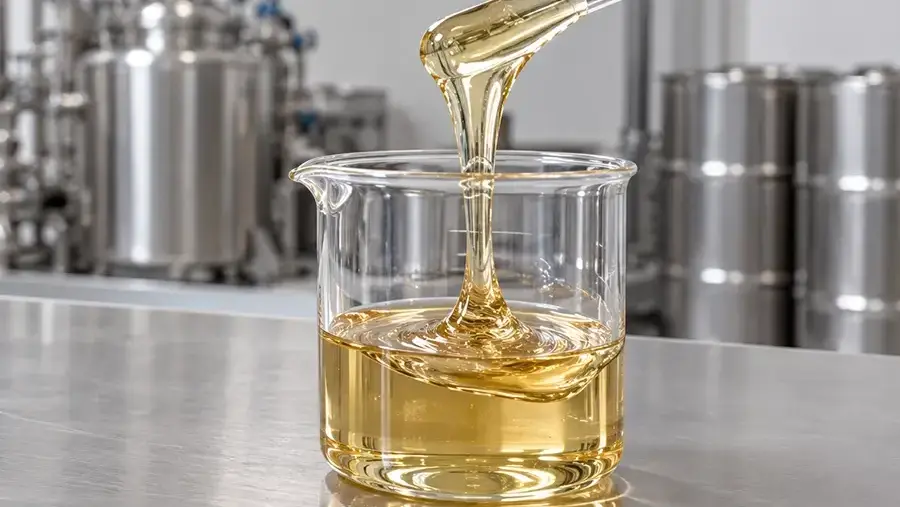
Viscous Hydroxyl-Terminated Polybutadiene (HTPB) resin being poured into a glass beaker in an industrial laboratory.
What Is HTPB?
HTPB is the standard abbreviation for Hydroxyl-Terminated Polybutadiene. It is a low-molecular-weight telechelic liquid rubber: the polybutadiene chain carries reactive hydroxyl groups at or near its ends. These hydroxyl groups allow the material to function as a polyol in reactions that form polyurethane networks.
The hydrocarbon backbone gives HTPB useful resistance to water and hydrolysis, low moisture permeability, electrical insulating behavior and flexibility at low temperatures. The final properties depend on the selected HTPB grade, the rest of the formulation and the controlled manufacturing process used by the customer.
The commonly referenced CAS number is 69102-90-5, described as 1,3-butadiene homopolymer, hydroxy-terminated. Modified, hydrogenated or otherwise functionalized liquid polybutadienes may use different identifiers. Purchase documents should state the full chemical name, CAS number, manufacturer grade and approved specification.
Is HTPB the Same as Polybutadiene Rubber?
No. Conventional polybutadiene rubber used in tires and general rubber goods is normally a high-molecular-weight solid elastomer. HTPB is a lower-molecular-weight reactive liquid with hydroxyl functionality. Both materials are derived from butadiene, but their molecular architecture, processing behavior and intended uses are different.
There is also a 1,2-butadiene isomer, although it has far less commercial importance and behaves differently. To avoid confusion with that isomer, mixed C4 streams or butadiene-based polymers, purchase documents should state 1,3-Butadiene, CAS 106-99-0, EC 203-450-8, followed by the required grade, specification and inhibitor range.
Key HTPB Product Data
Commercial values vary by grade. As an illustration, widely used free-radical HTPB products are published with number-average molecular weight around 2,800 to 3,050 g/mol, viscosity around 4,000 to 5,500 mPa.s at 30 degrees C, hydroxyl number around 44 to 51 mg KOH/g and hydroxyl functionality near 2.4. Other legitimate HTPB families use different molecular architectures and property ranges.
These figures are benchmarks, not universal acceptance limits. Temperature and test method have a large effect on viscosity results, while molecular-weight and hydroxyl-value methods can also differ. The contractual specification must identify the method and conditions for every critical parameter.
How HTPB Is Manufactured?
HTPB is produced by controlled polymerization of butadiene using chemistry designed to introduce hydroxyl functionality into the liquid polymer. Commercial routes include free-radical processes and living anionic polymerization. The selected route influences chain structure, molecular-weight distribution, hydroxyl placement and vinyl content.
Free-radical HTPB is established in general-purpose and aerospace-qualified product families. Living anionic processes can produce both-end hydroxyl-terminated diols with a different, often higher 1,2-vinyl microstructure. These products may all be described as hydroxyl-terminated polybutadiene, but they should not be substituted for one another without laboratory evaluation and formal approval.
Manufacturing control extends beyond polymerization. Removal of residual volatiles, moisture control, stabilization, filtration, blending and batch-release testing all influence the consistency received by the customer. For demanding applications, the manufacturer's control of batch-to-batch variation is as important as the nominal property range.
HTPB Grades and Specification Parameters
A request for HTPB should identify the required product family and application. General-purpose industrial grades, tightly controlled aerospace grades, hydroxyl-terminated diols and hydrogenated or modified derivatives are separate purchasing categories.
This explains why the butadiene market is closely tied to the operating pattern of refineries, steam crackers and integrated petrochemical sites. A change in cracker feedstock, a maintenance turnaround or stronger captive demand can quickly affect merchant availability.
Some markets also use on-purpose production based on the dehydrogenation of butanes or butenes, while renewable and circular routes remain under development. Whatever the route, buyers need to compare the finished product rather than assume that two sources are interchangeable. The analytical profile, inhibitor system, documentation and process compatibility are what ultimately matter.
Hydroxyl Number and Functionality
The hydroxyl number indicates the concentration of reactive hydroxyl groups. Functionality describes the average number of hydroxyl groups associated with each polymer molecule. Both values affect network formation and cured properties, so they must be tied to an agreed analytical method.
Molecular Weight and Distribution
Number-average molecular weight and molecular-weight distribution influence viscosity, crosslink density and mechanical behavior. Two grades with similar viscosity can still behave differently if their chain architecture or functionality is not equivalent.
Viscosity
Viscosity is central to pumping, mixing, filler wetting and processing. The result is meaningful only when the temperature, instrument and test method are stated. A value at 30 degrees C should not be compared directly with a value reported at 40 or 45 degrees C.
Moisture Volatiles and Peroxide Residues
Moisture can interfere with isocyanate-based systems and may create processing defects. Volatile matter, residual peroxide and other trace components can affect storage behavior and sensitive applications. Limits should be defined in the purchase specification and checked on the Certificate of Analysis.
Microstructure and Stabilization
The relative content of 1,2-vinyl, cis-1,4 and trans-1,4 units changes the polymer's reactivity and physical behavior. Antioxidants or stabilizers may also differ by grade. Customers qualifying an alternative source should review these features rather than matching only viscosity and hydroxyl number.
Main Applications of HTPB
Adhesives and Sealants
HTPB is used as a reactive polyol in polyurethane adhesives and sealants where water resistance, hydrolytic stability, adhesion and low-temperature flexibility are important. Applications include construction, automotive assemblies, insulated glazing and specialty industrial bonding.
Electrical Potting and Encapsulation
The hydrophobic hydrocarbon backbone and electrical insulating properties make selected HTPB grades useful in potting and encapsulation systems. Final suitability depends on dielectric requirements, thermal cycling, adhesion, cure system and the complete formulation.
Coatings and Waterproofing
HTPB can contribute flexibility, water resistance and chemical resistance to protective coatings, membranes and waterproofing products. It is also used in specialized binders and bitumen-modified systems.
Polymer and Rubber Modification
Liquid polybutadiene can modify toughness, flexibility, adhesion and processing behavior in selected polymer, rubber and resin systems. Compatibility and the chosen reaction pathway must be evaluated for each formulation.
Aerospace and Propulsion Binders
Qualified HTPB grades are used as polymeric binders in authorized solid and hybrid propulsion systems. After curing, the binder forms the elastomeric matrix that holds the grain together and supports mechanical integrity during storage and operation. Aerospace grades require controlled specifications, traceability, qualification and regulatory review. A general industrial grade should not be substituted into a qualified system. In qualified composite propellant formulations, HTPB is cured with an isocyanate curing agent such as DDI (Dimeryl Diisocyanate) and used together with bonding agents such as HX-752 and HX-878 to improve adhesion between the binder and oxidizer particles. The complete propellant system typically includes ammonium perchlorate as the oxidizer and aluminium powder as the metallic fuel.
HTPB in the EU and Europe
Buyers sometimes use EU and Europe as if they mean the same market. They do not. The European Union is a customs and regulatory area of 27 Member States, while Europe also includes the United Kingdom, Switzerland, Norway, Turkey, the Western Balkans and other countries with their own legal requirements. This difference affects customs, chemical compliance and the party responsible for placing HTPB on the market.
Under REACH, substances that meet the definition of a polymer are generally exempt from registration, but the monomers and other substances used to manufacture the polymer can still create obligations. This is not a blanket exemption from European chemical compliance. The importer and supplier must confirm the substance identity, polymer status, relevant monomer coverage, additives, Safety Data Sheet and the role of each supply-chain participant.
EU transactions may also require CLP classification and labelling, national-language safety information, customs documentation, workplace controls and waste-management planning. Aerospace or controlled grades can bring export-control, destination and end-use requirements. Great Britain applies its own UK REACH and customs framework.
Regions Where HTPB Is Manufactured
Commercial HTPB production is concentrated among specialist polymer manufacturers with controlled access to butadiene, established polymerization technology and demanding quality systems. A seller's office, warehouse or local distributor does not establish manufacturing origin. The plant named on the Certificate of Origin and batch documents is the relevant source. The country notes below distinguish confirmed production sites from markets that mainly import, store or redistribute the material, based on publicly available plant information reviewed for this article.
European Union and Wider Europe
Europe has documented HTPB manufacturing in Germany and Italy. Evonik produces POLYVEST HT at its integrated Marl site in Germany, where HTPB capacity was expanded in 2024 and a further expansion is scheduled to enter service in 2027. Resin Solutions identifies Ravenna, Italy, as its European Poly bd HTPB production site for industrial and qualified aerospace markets.
For buyers seeking Hydroxyl-Terminated Polybutadiene manufacturers in the EU, these facilities show that European production exists. They do not guarantee open merchant availability. Grade qualification, export controls, production allocation, minimum order quantity and the proposed destination still determine whether a specific enquiry can be served.
United States
The United States has a long-established HTPB production base serving industrial, aerospace and defense applications. Resin Solutions identifies Channelview, Texas, as its principal North American Poly bd HTPB plant. Some U.S.-origin grades are subject to export controls, so a technical match does not by itself establish export eligibility.
China
China has domestic HTPB production for industrial and controlled applications. Tanyun Aerospace Materials lists HTPB under CAS 69102-90-5 and identifies production plants in Yingkou and Yichang. Chinese suppliers offer multiple hydroxyl-value and viscosity ranges, which makes exact grade and test-method matching essential.
Marketplace listings should not be treated as proof of production. Buyers should request the legal name of the plant, current specification, quality certificates, batch data, country-of-origin documents and confirmation that export is permitted for the destination and end use.
Japan
Japan manufactures hydroxyl-functional liquid polybutadienes for industrial markets. Nippon Soda's Chiba Plant lists NISSO-PB among its manufactured products, and the company's G Series is a both-end hydroxyl group-terminated polybutadiene produced by living anionic polymerization. These high-vinyl diol grades have a different structure from common free-radical HTPB and require application-specific qualification.
India
India has domestic HTPB manufacturing capability connected to its space, defense and industrial sectors. Indian public procurement documents have required bidders to operate their own HTPB plants and demonstrate production history, capacity and batch records. Indian manufacturers also market HTPB and related propellant additives to government and industrial customers.
For imported or domestic Indian material, the buyer should verify whether the offered grade is industrial, aerospace or specification-controlled, and whether the manufacturer has been approved for the intended program. A domestic address or trading registration is not a substitute for plant qualification.
Saudi Arabia
Saudi Arabia belongs in this overview because it has a large petrochemical base, domestic conventional polybutadiene-rubber production and an active industrial-localization program. That combination supports demand for specialty polymers and qualified aerospace materials, but it is not evidence of HTPB production.
At the time of writing, no large commercial HTPB plant in the Kingdom could be verified from public manufacturer or project information. A Saudi quotation should consequently identify the overseas producer and country of origin, as well as the import approval and any end-user or sector licence required for the application.
Singapore
Singapore is an important Asian center for chemicals, storage, logistics and transshipment. Jurong Island hosts an integrated energy and chemicals cluster with more than 100 global companies and direct access to regional supply chains. Public plant information reviewed for this article did not identify a large domestic HTPB production site.
In practical terms, Singapore is primarily an import, distribution and re-export point for HTPB. A Singapore-based supplier may still offer a suitable product, but the offer should state who made it, where it was made, the grade and batch documents, and whether the proposed import or transshipment route is permitted.
United Arab Emirates
The United Arab Emirates is expanding its chemical manufacturing base around Ruwais and the TA'ZIZ industrial ecosystem. It also has strong port, storage, re-export and advanced-manufacturing capabilities. Current public project lists cover products such as methanol, ammonia, PVC-chain chemicals and proposed isocyanate capacity. None of the published projects reviewed for this article identifies a large merchant HTPB plant.
The UAE is currently better understood as a procurement, logistics and demand market for HTPB than as a confirmed manufacturing origin. An offer described as UAE supply may be imported stock. The original manufacturer, country of origin, export authorization, local import permissions, storage arrangements and end-user documentation should all be clear before an order is placed.
Taiwan
Taiwan has a substantial petrochemical, synthetic-rubber and specialty-materials sector. Local companies manufacture conventional synthetic rubbers and advanced materials, and the island is an important regional technology and trading market. Even so, the public record reviewed for this article did not reveal a large commercial HTPB plant in Taiwan.
For a Taiwan-based offer, ask for the plant name and address rather than assuming that the seller is the producer. The purchase file should include the Certificate of Origin, manufacturer specification, Safety Data Sheet and batch Certificate of Analysis. Warehousing or resale in Taiwan does not change the product's manufacturing origin.
Selecting HTPB Manufacturers
The right HTPB manufacturer is the one that can reproduce the required chemistry and analytical profile, release consistent batches and support the proposed destination and end use.
The review should cover:
-
Product identity: full chemical name, CAS number, manufacturer grade and actual production site.
-
Specification capability: molecular weight, hydroxyl number, functionality, viscosity, moisture, volatiles and any application-specific limits.
-
Process and microstructure: polymerization route, vinyl content, cis and trans distribution, and approved stabilizer system where relevant.
-
Quality assurance: calibrated methods, batch blending controls, traceability, deviation management and retained samples.
-
Qualification history: evidence that the grade is suitable for the intended industrial or aerospace application.
-
Regulatory eligibility: export status, country restrictions, end-use review and documentation for the proposed transaction.
-
Supply continuity: realistic allocation, minimum order quantity, lead time, expansion plans and alternative-source strategy.
Selecting HTPB Suppliers in Europe
A qualified HTPB supplier in Europe must connect the customer's specification to a named and approved manufacturing source. The offer should identify the producer, production country, grade, quantity, delivery window, packaging, Incoterms and documents included with the shipment.
For an EU delivery, the supplier should also address REACH and CLP responsibilities, customs status, Safety Data Sheet language, export or re-export restrictions and the regulatory role of the importer. When the product is intended for an aerospace or other controlled application, end-user and end-use documentation should be reviewed before production or stock is allocated.
Price should be compared only after the sources are technically equivalent. A lower quotation has little value if the grade has not been qualified, the country of origin is unclear or the material cannot be licensed and delivered to the receiving site.
Quality Control and Batch Documentation
HTPB performance depends on a set of related properties rather than a single purity figure.
The agreed quality plan may include:
-
Substance and manufacturer identification.
-
Appearance and color.
-
Viscosity at the specified temperature and by the specified method.
-
Hydroxyl number or hydroxyl value.
-
Hydroxyl functionality where required.
-
Number-average molecular weight and molecular-weight distribution.
-
Moisture content.
-
Volatile matter.
-
Residual peroxide, acidity or other trace parameters where specified.
-
Microstructure or vinyl content for applications sensitive to chain architecture.
-
Stabilizer or antioxidant identity and level where controlled.
-
Batch traceability, blending records and retained samples.
-
Certificate of Analysis, Safety Data Sheet and Certificate of Origin.
The Certificate of Analysis should refer to the delivered batch or lot and use the test methods agreed in the purchase specification. For a new source, a representative sample and customer qualification are normally required before commercial delivery.
Packaging Storage and Handling
HTPB is a viscous liquid and is commonly supplied in sealed steel drums, intermediate bulk containers or bulk tankers, depending on the grade, source and quantity. One current European commercial example lists 180 kg steel drums, 850 kg IBCs and road-tanker delivery. These pack sizes should not be assumed for every manufacturer.
Storage conditions are also grade-specific. A published commercial recommendation for one HTPB family calls for protection from air, light and moisture at temperatures below 25 degrees C and states a one-year storage period. The controlling instructions are always the current manufacturer Technical Data Sheet and Safety Data Sheet for the supplied grade.
Packaging integrity matters because moisture ingress, contamination or extended exposure to air can affect sensitive formulations. The receiving site should confirm unloading capability, container handling, storage temperature, stock rotation and any approved conditioning procedure before the shipment is released.
Transport and Regulatory Compliance
There is no single transport classification that can be assigned to every product sold as HTPB. Some unmodified grades are not classified as dangerous goods for transport, while additives, modified products or national rules can change the position. The manufacturer's current Safety Data Sheet and the responsible dangerous-goods specialist must determine the classification for the exact product and route.
Separate export-control rules may apply even when the material is not dangerous for transport. Manufacturer literature for selected U.S. and German HTPB grades states that export authorization may be required. Origin, grade, destination, consignee, end user and intended use must therefore be reviewed before a binding delivery commitment is made.
An international shipment may require a commercial invoice, packing list, Certificate of Analysis, Safety Data Sheet, Certificate of Origin, export license, import approval, end-user certificate and transport documents. The exact package depends on the countries and application involved.
The European HTPB Supply Chain
European buyers can source from HTPB manufacturers in the EU or import approved grades from North America and Asia. The practical route depends on technical qualification, production allocation, export eligibility, packaging, customs position and the customer's delivery schedule.
Supply continuity deserves early attention because HTPB production is concentrated among a limited number of specialized plants. Expansion projects in Germany, Italy and the United States may improve capacity, but they do not remove the need for forecasts, reserved allocation and source approval. A backup manufacturer is useful only after the alternative grade has passed the customer's qualification process.
Long lead-time programs should align demand forecasts with manufacturing slots and regulatory approvals. Changes to the plant, process, stabilizer, specification or packaging should be subject to formal change control where the application requires it.
Information Required for a Quotation
A supplier can assess an enquiry properly when the request for quotation includes:
-
Product name, common CAS number and manufacturer grade if already approved.
-
Complete technical specification and revision.
-
Required molecular-weight range and analytical method.
-
Hydroxyl number, functionality and viscosity limits with test conditions.
-
Moisture, volatile, peroxide, microstructure, antioxidant and other critical limits.
-
Industrial, aerospace or other authorized application.
-
Required quantity, annual forecast and requested delivery schedule.
-
Preferred packaging and receiving-site limitations.
-
Destination, consignee, final end user and country of use.
-
Required certificates, inspection and sample-approval process.
-
Preferred Incoterms and customs responsibilities.
-
Import-license status and any end-user or end-use documents already available.
-
Restrictions on manufacturer or country of origin.
Without this information, an offer may describe an available HTPB product rather than the grade that the customer can actually approve and use.
How ORBITALA Supports Qualified Buyers
ORBITALA OOD supports qualified industrial and aerospace-sector organizations sourcing specialty polymers and chemical raw materials. For HTPB projects, the work begins by defining the exact material and separating general liquid polybutadiene, industrial HTPB and tightly controlled application grades.
Support may include:
-
Reviewing the HTPB grade, specification and intended application.
-
Identifying suitable manufacturers and confirming the actual production origin.
-
Comparing viscosity, hydroxyl value, functionality, molecular weight and other critical parameters.
-
Coordinating samples, qualification documents and batch certificates.
-
Aligning packaging, labelling and delivery requirements.
-
Reviewing REACH, CLP, customs and country-specific supply-chain obligations.
-
Coordinating export, import, end-user and end-use documentation where required.
-
Planning production allocation, inspection and delivery schedules.
Any supply remains subject to technical acceptance, product availability, regulatory approval, destination, end user and authorized end use. ORBITALA does not present a distributor's location as manufacturing origin and does not arrange controlled supply without the required documentation.
Frequently Asked Questions
Request Information About HTPB
Qualified organizations seeking HTPB, Hydroxyl-Terminated Polybutadiene manufacturers in Europe or access to approved HTPB suppliers in the EU are invited to contact ORBITALA OOD.
Please provide the required grade or specification, quantity, destination, consignee, final end user, application, delivery schedule, packaging needs and any available import or end-user documents. ORBITALA will assess whether a technically suitable, commercially viable and legally compliant supply route can be developed.